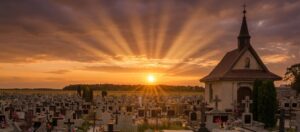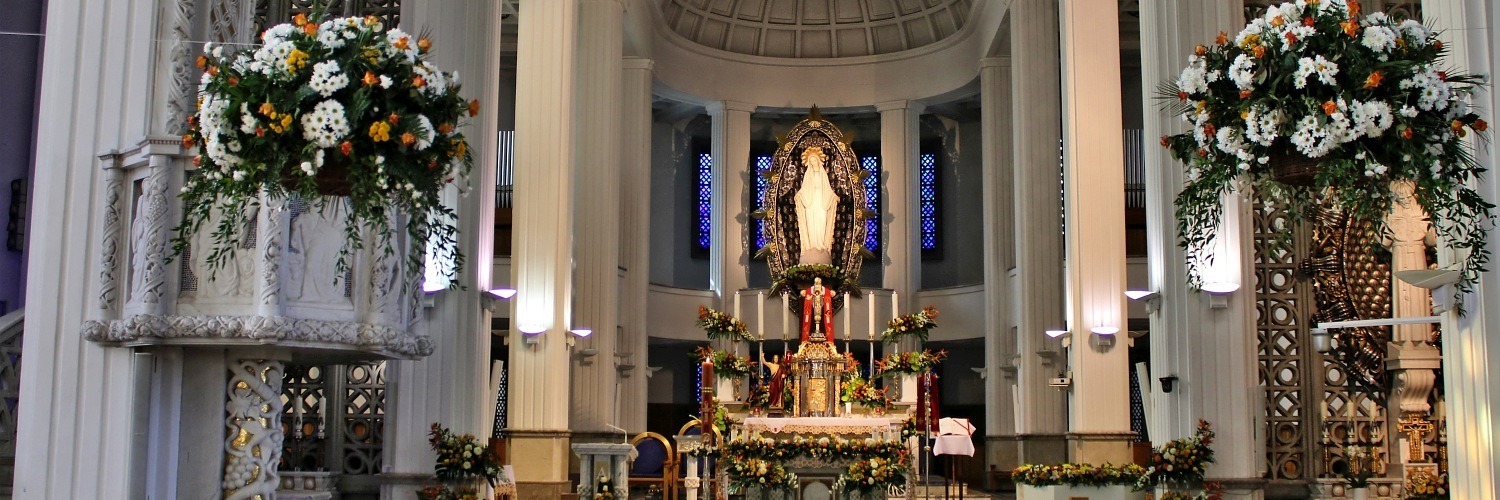
Minor Basilica in Niepokalanów, built in 1948-54 (e-guide)
Upon crossing the gates of Niepokalanów, the pilgrim beholds the majestic silhouette of the church, that towers over the entire monastic complex. The Basilica of the Immaculate Mediatrix of All Graces is not only a parish church or simple shrine; it’s a sacred space where history, spirituality, and ceaseless prayer are woven into a single narrative. This modernist sanctuary, raised with great toil amidst the hardships of the post-war era, stands today as one of the preeminent spiritual and cultural heartlands of the Mazovia region in Poland.
* A Vision Stronger Than War
A need for a grand church in Niepokalanów first stirred in the hearts of the friars in the 1930s. The humble wooden chapel, built some years prior, could no longer accomodate the growing number of religious brothers and local faithful. Architectural plans were finalized and approved in Warsaw in December 1938. By May 1939, a cross was raised on the building site, and the first foundations were laid. Alas, the outbreak of the Second World War halted all progress, and the gathered building materials were plundered by the Nazi occupiers.
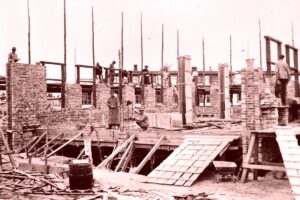
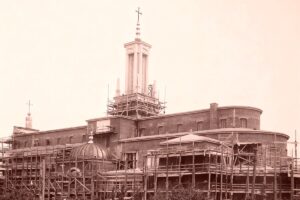
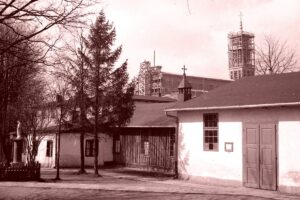
Following the war’s end, the Franciscans brothers were confronted with the arduous task of rebuilding the monastery and restoring their publishing apostolate. Yet the vision of building a church did not fade; on the contrary, it acquired a renewed and deeper significance. Following the martyrdom of Fr. Maximilian in Auschwitz in 1941, his witness began to draw ever greater multitudes of pilgrims to Niepokalanów. The need for a spacious church thus became evident. In 1948, under the direction of Zygmunt Gawlik, an architect from Kraków, construction works began. Despite shortages of materials, administrative restrictions, and unceasing difficulties, the Franciscans, together with the faithful, brought the undertaking to its completion.
The construction utilized modern structural solutions for its time, yet great care was taken to ensure the edifice maintained Franciscan simplicity and clarity of form. The solemn consecration took place in October 1954. As the Primate of Poland, Stefan Cardinal Wyszyński, was then imprisoned by the communist authorities, the rite was performed by bishops Wacław Majewski and Karol Niemira. From that moment, the church became the spiritual heart of the Franciscan community and the pilgrim path.
During a celebration in honor of St. Maximilian, Cardinal Stefan Wyszyński observed:
„Before the war, Niepokalanów grew in breadth and length. Then came the difficult post-war years, and the Franciscans, unable to pursue their former labors, did the wisest thing they could possibly do – they built a church. They moved from the wide fields filled with barracks into the sanctuary, reminding the Order, the nation, and all of us of the most vital truth: 'To the temple! To strengthen the spirit upon our knees!'”
* Architecture of the church. Modernism
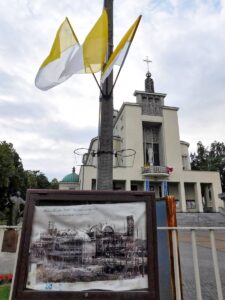
The basilica is an orientated church, designed in the modernist style. Its proportions inspire admiration: 69 metres in interior length, 33 metres in width at the level of the side chapels, and 16 metres in the height of the nave, all of which lend the space an atmosphere of serenity and solemn dignity. The characteristic tower, rising to 47 metres, houses a clock with five faces and four bells: Rycerz Niepokalanej, Maksymilian, Franciszek and Antoni. The statue of the Immaculate, placed above the main entrance, is not merely decorative, but a symbol of the spiritual identity of the whole of Niepokalanów: everything here leads to Mary, and through Her – to Christ.
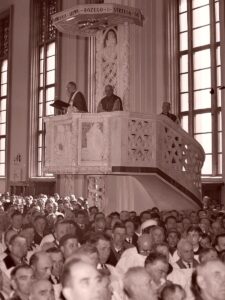
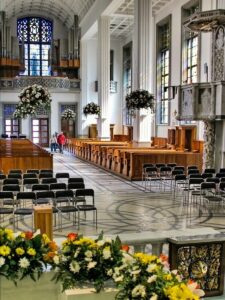
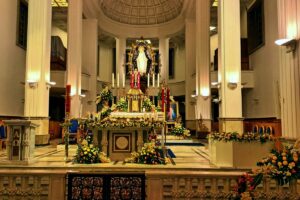
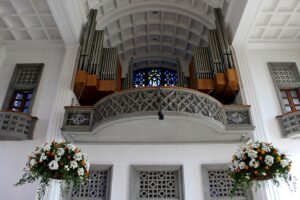
The interior of the basilica is spacious, with large windows allowing an abundance of natural light to enter. The high altar, rendered in light tones, draws attention to the statue of the Immaculate, Mediatrix of All Graces – the patroness of the church. In the nave, particular notice is drawn to the pulpit of white Tuscan marble, adorned with bas-reliefs of the Holy Trinity, the four Evangelists, and Christ teaching from a boat. The basilica is equipped with two organs: a 16-stop instrument in the presbytery and a 49-stop instrument in the choir loft. On the days of great solemnities, such as the Midnight Mass of Christmas and Holy Week, the presbytery and the nave are illuminated by dozens of lights, reflecting the joy of the liturgy.
* Prayer, Silence, and Reflection
Although more than 70 years have passed since its construction, the basilica has lost none of its relevance. On the contrary – at a time when many people are searching for silence, meaning in life, and spiritual support, Niepokalanów is becoming a truly special place. The basilica is open throughout the day, allowing pilgrims to come at any time with their intentions and prayers. Its actual capacity (approx. 3,000 people) makes it possible to host large nationwide gatherings and celebrations (e.g., the monthly “Entrust Yourself to Mary” meeting).
The Basilica is not only a building, but also a story of faith that has endured wars, poverty, persecution, and hardship. It stands as a testimony that the dreams of saints – even if they are not fulfilled within their lifetime – can become reality through the persistent efforts of their successors. Every pilgrim who crosses the threshold of this church can find something here: prayer, silence, reflection, and sometimes even answers to the questions they carry in their hearts.
* The Chapels: from the history of Poland to a prayer for peace
The basilica contains places of particular symbolic significance:
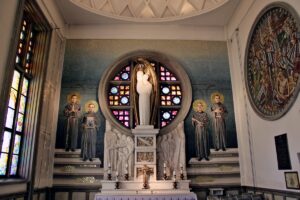
Chapel of St. Maximilian (left transept): The central focus is a statue of the saint who, in a gesture of self-offering, presents the globe of the earth to the Blessed Virgin Mary. The background is filled with a mosaic commemorating four Blessed martyrs of Niepokalanów, collaborators of St. Maximilian (Fr. Pius, Fr. Antoninus, Br. Boniface, Br. Timothy).
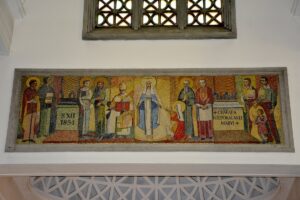
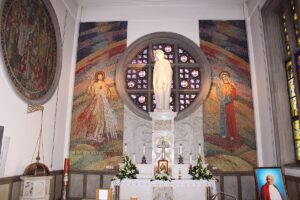
Chapel of St. Joseph (right transept): Here you will find a circular mosaic commemorating the Baptism of Poland, alongside with figures of workers and farmers offering God the fruits of their labor. In 2002, large wall mosaics were installed – of the Merciful Jesus and the Immaculate Heart of Mary.
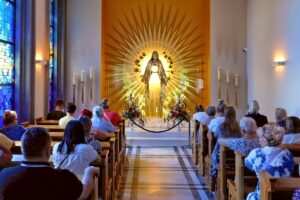
“Star of the Immaculate” Chapel (southern wing): Since 2018, the basilica has housed a chapel of perpetual adoration. It was designed as one of twelve centers of adoration and prayer across different continents, dedicated to the intention of peace throughout the world. Its unique altar, made of silver, gold, and crystal, impresses with its precision craftsmanship.